Zona Logo
Google Gemini
AI Assistants & Chatbots
Rated 5.0/5 from 3,122 votes
Brand Info
Report outdated or incorrect assets.
7+ Google Gemini Logo PNG & SVG Vectors HD Quality
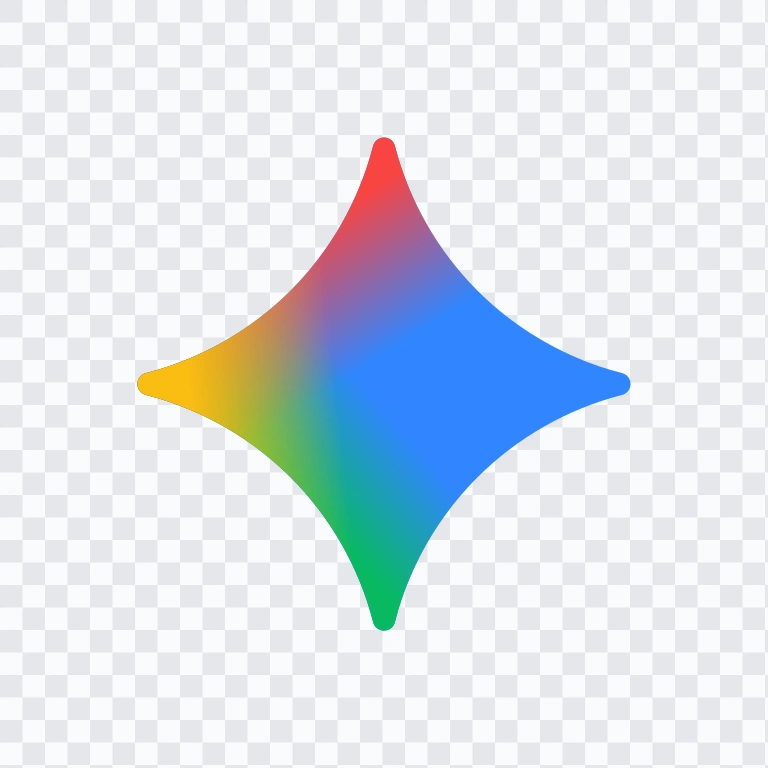


Table of Contents11 sections
- Download Google Gemini PNG Logo
- About Google Gemini
- Meaning and History of the Google Gemini Logo
- Evolution of the Logo
- Google Gemini Color Palette
- Frequently Asked Questions
- Can I use the Google Gemini logo for commercial purposes?
- What file formats are available?
- What does the Gemini symbol represent?
- When did Bard become Gemini?
- Why do people look for a “Google Gemini logo” in vector form?
Welcome to Zona Logo. You can download the Google Gemini logo in PNG and SVG formats. You can also download the PNG logo with a transparent background in high resolution (HD) for free.
Download Google Gemini PNG Logo
Please select the file above according to your needs, then press the download button to obtain the desired file:
| File Name | Google Gemini |
| File Type | PNG, SVG |
| File Size | 18 KB - 240 KB |
If you encounter issues while downloading the Google Gemini logo or if the provided link is inaccessible, you can report it through the Contact Us page.
About Google Gemini
Google Gemini is Google’s multimodal generative AI assistant and model family, positioned at the center of the company’s modern AI strategy. First announced on December 6, 2023, it consolidated and replaced several overlapping AI product identities across Google, most notably when the Bard chatbot was renamed Gemini in February 2024 and “Duet AI” in Workspace and Cloud transitioned to the Gemini name. In the market, it competes with other frontier model ecosystems by emphasizing deep integration across consumer products, developer tooling, and enterprise platforms.
At a product level, it spans both an assistant experience (mobile app and system-level assistance on Android) and a developer-facing platform via Google Cloud’s Vertex AI, where builders can incorporate the models into applications, agents, and workflows. Strategically, the brand’s value proposition combines three pillars: capability (strong reasoning and coding), multimodality (text, images, audio, and video), and availability (scaled variants for different latency and cost profiles). The model lineup is often described in tiers—from efficient on-device versions (commonly framed as “Nano”) to faster throughput options (“Flash”) and high-compute configurations (“Pro” and “Ultra”) aimed at complex reasoning and advanced workloads.
Public perception has been shaped by both technical praise and controversy. Benchmark performance and developer utility have been widely discussed, while early releases faced scrutiny around reliability and mistakes typical of generative systems. A notable moment in early 2024 was the temporary suspension of the feature that generated images of people, following criticism over historical inaccuracies and bias. Subsequent iterations, including the Gemini 1.5 and 3 series released across 2025, highlighted improvements in latency, expanded context windows for long documents and codebases, and more agentic behaviors suited to research and software development.
Meaning and History of the Google Gemini Logo
The Google Gemini logo is designed to read as both a product identity and a system identity—a mark that needs to live comfortably inside a dense Google ecosystem while still signaling a distinct AI capability. Rather than relying on a literal mascot or chatbot iconography, the identity language leans into the idea of a “dual” or “paired” intelligence implied by the Gemini name: two complementary forces working in concert (analysis and creativity, assistant and model, user intent and machine output).
In typical use, the visual identity is built around a compact brand symbol that functions well at app-icon sizes and in UI surfaces where clarity is paramount. The mark’s geometry favors clean curves and balanced negative space, aligning with Google’s broader approach to friendly, accessible, and scalable interface design. This kind of minimal construction is not merely aesthetic; it supports legibility in small sizes, quick recognition in notification trays, and consistent rendering across variable pixel densities.
Typography and lockups generally align with Google’s established wordmark conventions, using a contemporary sans-serif style consistent with the parent brand’s interface-first design system. This continuity is deliberate: it communicates that the assistant is a first-party capability, not a standalone startup. When users search for assets such as a Google Gemini PNG or a Google Gemini SVG, they are often looking for a vector format that preserves crisp edges for UI mockups, presentations, and design systems—use cases the brand’s minimal, grid-friendly mark supports especially well.
Design takeaway: the identity aims to be “quietly distinctive”—recognizable in a crowded AI landscape, yet compatible with the broader Google visual language across products, surfaces, and partners.
Evolution of the Logo
Gemini’s brand evolution is tightly linked to Google’s consolidation of its AI naming architecture. The earliest public-facing phase was associated with Bard, which had its own naming and presentation conventions. The shift to the Gemini name in 2024 signaled more than a rename: it reframed the assistant as part of a model family that would appear across consumer, workspace, and cloud contexts.
As the system matured, the identity stabilized around consistent iconography suitable for app stores, OS overlays, and in-product placements. This stability is important for an assistant that appears in multiple modalities—chat, search-like interactions, content creation tools, and developer consoles—where a fragmented identity would erode trust. Over time, refinements have focused on cross-platform consistency and on ensuring the official emblem remains readable at small sizes, including dark-mode and high-contrast environments. In practical terms, that often translates into careful adjustments to stroke weight, spacing, and color behavior across backgrounds.
Google Gemini Color Palette
Google does not always publish a single, fixed palette for every sub-brand as rigidly as a traditional consumer packaged-goods identity might. However, Gemini typically inherits Google’s broader visual sensibilities: clean neutrals, generous whitespace, and selective use of bright, familiar Google hues. In many UI contexts, the symbol appears in a gradient or multi-tone treatment that evokes the parent brand’s color energy while remaining distinct enough to signify “AI assistant” rather than a generic Google service.
When creators need dependable color references for design comps, these commonly used Google core colors provide a practical starting point:
- Google Blue: #4285F4
- Google Red: #EA4335
- Google Yellow: #FBBC05
- Google Green: #34A853
- Charcoal (UI text approximation): #202124
- Light Gray (surface approximation): #F1F3F4
Because implementations can vary by platform and theme, designers should treat these as reference values and verify against official brand resources when accuracy is critical (especially for print, partner marketing, or app store submissions). If you need a file for mockups, choose an asset with a transparent background so it can be placed cleanly on light and dark surfaces.
Frequently Asked Questions
Can I use the Google Gemini logo for commercial purposes?
For commercial use, it’s best to request official permission from Google and follow their trademark and brand guidelines. Even well-intended uses (such as packaging, ads, or product UI) can require approval to avoid confusion or implied endorsement.
What file formats are available?
Common downloadable formats are PNG and SVG. PNG is convenient for quick placement, while SVG is ideal for resizing without quality loss.
What does the Gemini symbol represent?
It generally communicates duality and collaboration—two “sides” working together—matching the product’s positioning as an assistant that combines reasoning with generative creativity, and as a model family that spans multiple sizes and capabilities.
When did Bard become Gemini?
The Bard chatbot was renamed Gemini in February 2024, aligning the assistant’s public identity with the underlying model family and unifying Google’s AI branding across consumer and enterprise surfaces.
Why do people look for a “Google Gemini logo” in vector form?
Designers and developers often need the official mark for slides, UI prototypes, press materials, and documentation. A scalable vector version keeps edges sharp at any size and is easier to recolor or place consistently within a broader visual identity system.
AI-Generated Content
This description was generated by AI and may contain inaccuracies.